Office Reception Flowers: How to Choose Arrangements That Reflect Your Brand
Your reception area speaks before your receptionist does. The lighting, furniture, scent, artwork, desk, flooring, signage, and yes, the flowers, all tell visitors something about your company before anyone says hello. That is why office reception flowers deserve more thought than simply ordering “something nice” every Monday morning. The arrangement sitting at the front desk is part of your visual identity, and when it is chosen well, it can reinforce the way you want clients, candidates, partners, and employees to feel when they walk through the door.
A law firm and a fashion studio should probably not have the same floral arrangement. Neither should a luxury real estate company and a playful tech startup. Even if both offices are beautifully designed, their flowers should express different personalities. One may call for sculptural white orchids and restrained greenery. Another might look better with unusual seasonal stems, saturated color, or an asymmetrical arrangement with more attitude.
That does not mean the flowers need to match your logo like a paint swatch. In fact, literal branding can quickly become heavy-handed. The smarter approach is to translate the character of the business into floral design. A company known for precision may benefit from clean architectural arrangements. A wellness brand may prefer softer, more organic forms. A hospitality company may need flowers that feel warm and inviting. A luxury brand may want fewer flowers, but each stem should feel intentional.
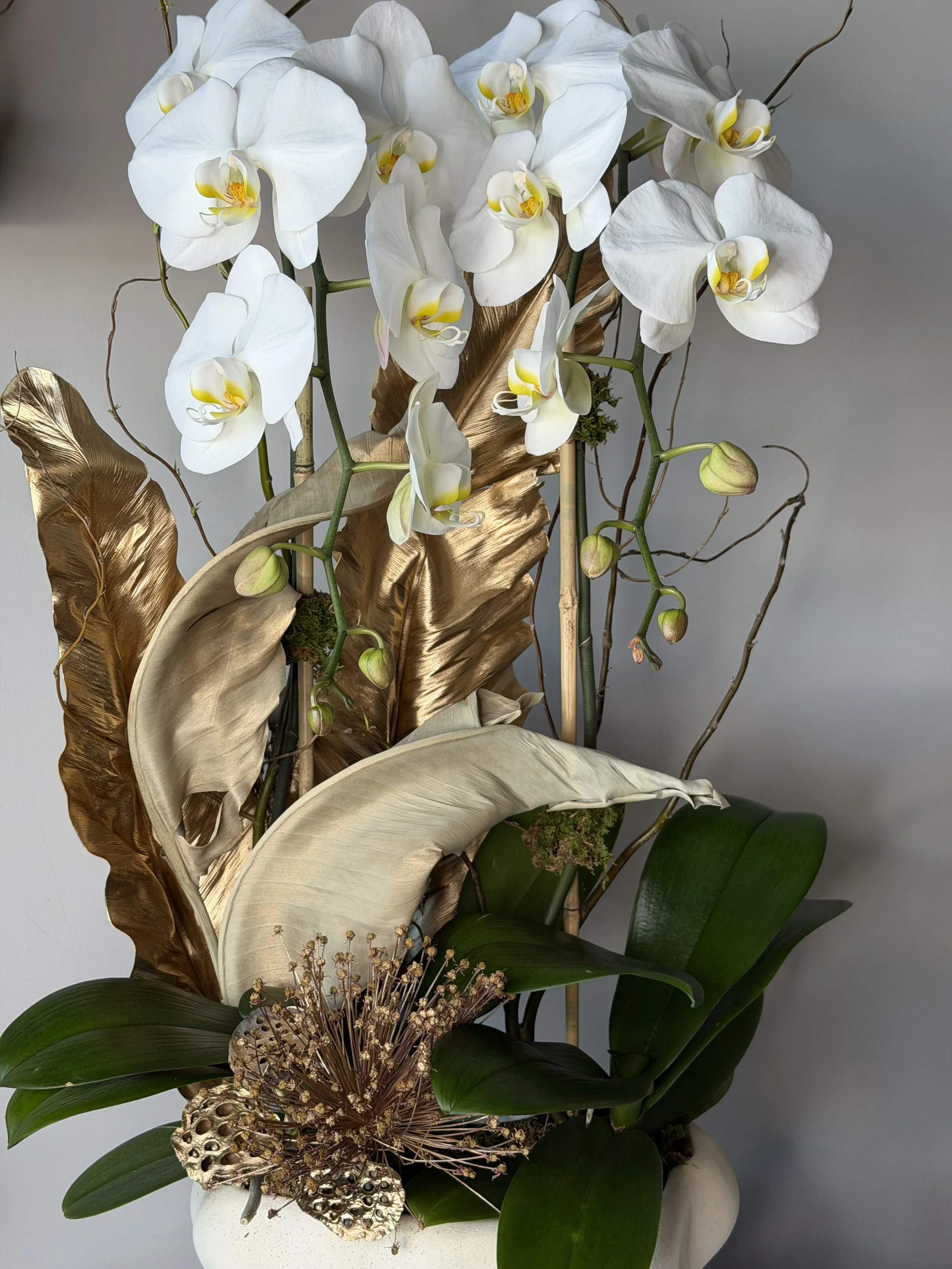
Good reception floral design also has to work practically. The arrangement cannot block the receptionist’s view, interfere with paperwork, overwhelm a small desk, or fill the lobby with a fragrance that bothers visitors. It needs to survive the week, look polished from multiple angles, and fit naturally into the architecture.
The goal is simple: when someone enters the office, the flowers should feel like they belong there. They should not look like a random bouquet was dropped on the desk. They should feel like another expression of the brand.
Why Office Reception Flowers Matter More Than You Think
Reception areas are strange spaces because they are both functional and symbolic. They are where deliveries arrive, visitors wait, employees pass through, and first impressions form. A client may spend only three minutes there, but those three minutes can influence how polished, welcoming, organized, or premium the company feels. Corporate reception flowers can help shape that impression in a surprisingly direct way.
Flowers signal care. A fresh arrangement tells people that someone is paying attention to the environment. That may sound like a small thing, but details matter in professional settings. If the flowers are fresh, the desk is tidy, the lighting is considered, and the space feels intentional, visitors often assume the same level of care extends to the business itself.
This is especially important for companies that regularly host clients in person. Luxury real estate offices, law firms, investment companies, design studios, medical practices, showrooms, hospitality groups, and professional services firms all benefit from reception spaces that feel composed rather than merely functional.
Flowers also soften corporate architecture. Offices often contain glass, metal, stone, polished wood, concrete, screens, and hard-edged furniture. A floral arrangement introduces movement, texture, and organic shape. It prevents the space from feeling too sterile without requiring a major design change.
There is also an emotional effect. Fresh flowers can make a lobby feel more welcoming and less transactional. That matters when someone is arriving for an important meeting, job interview, consultation, or negotiation. A well-designed reception area lowers the emotional temperature just enough to make the space feel human.
The key is consistency. A stunning arrangement one week and a tired grocery-store bouquet the next can make the space feel uneven. Reception flowers work best when they are treated as part of the company’s design system, not an occasional decoration.
That does not mean every arrangement must look identical. Seasonal variation is healthy. The point is that the quality, tone, and overall style should stay aligned with the brand.
People may not consciously say, “The flowers match this company perfectly.” Usually, they simply think the office feels right. That quiet coherence is exactly what good floral styling is supposed to achieve.
Start With Your Brand Personality, Not Your Favorite Flower
One of the easiest mistakes businesses make is choosing office flowers based on personal taste. The founder loves peonies, so the reception desk gets peonies. The office manager likes sunflowers, so yellow sunflowers appear every week. There is nothing wrong with those flowers, but the better question is whether they communicate the right thing about the company.
Your office flower arrangements should start with brand personality. Think about how your company wants to be perceived. Are you traditional or contemporary? Approachable or exclusive? Creative or conservative? Calm or energetic? Minimalist or expressive? Those qualities should guide the floral direction more than any one person’s favorite bloom.
A wealth management firm may want arrangements that feel stable, refined, and quietly expensive. Think white orchids, green hydrangeas, calla lilies, or structured seasonal branches. A creative agency may benefit from more unusual forms, color contrast, and unexpected materials. A wellness company might prefer soft neutrals, organic movement, herbs, branches, or botanical textures that feel connected to nature.
Even within the same industry, brand positioning changes the answer. Two law firms can communicate very differently. One may be traditional, established, and formal. Another may market itself as modern, accessible, and entrepreneurial. The flowers should reflect that difference.
It helps to think in adjectives before thinking in flower names. Choose three to five words that describe the brand. Maybe they are “modern, precise, calm, premium, discreet.” Or perhaps “bold, youthful, playful, creative, energetic.” Those words give a florist much more useful direction than simply saying, “We like white flowers.”
This also prevents the design from becoming too literal. A blue logo does not require blue flowers. A luxury company does not automatically need roses. A sustainable brand does not have to cover the front desk in eucalyptus.
The strongest floral concepts interpret the brand rather than copy it. That interpretation might show up through shape, texture, color temperature, scale, or vessel choice.
The flowers should feel like they belong to the company, not to whoever placed the order that week.
How to Match Floral Style to Your Company Image
Once you understand the brand personality, the next step is translating it into a floral style. This is where things get interesting because floral design has its own visual language. Shape, density, symmetry, texture, movement, and vessel choice can all communicate different things.
Structured arrangements feel polished and formal. Think tight groupings, controlled shapes, and symmetrical composition. These work well in traditional corporate environments, high-end professional services, or businesses that want to project precision and stability.
Loose, asymmetrical arrangements feel more modern and editorial. They may include stems extending in different directions, negative space, and varied heights. This style often works beautifully for creative companies, luxury fashion, architecture firms, or design-forward brands.
Monochromatic arrangements communicate restraint. A reception desk with only white orchids or only burgundy calla lilies can feel extremely sophisticated because the visual message is clear. Mixed arrangements can feel warmer and friendlier, but too many flower types and colors can start to look casual.
Minimalism is another strong option. One sculptural branch in a beautiful vessel can have more impact than a large bouquet if the space is clean and contemporary. This approach works especially well in offices where the architecture already carries the visual weight.
Texture can also express brand personality. Soft garden flowers feel romantic and approachable. Glossy tropical flowers feel modern and bold. Branches, seed pods, and grasses can feel natural, artistic, or even slightly raw.
Then there is the container. A floral arrangement in a clear glass vase feels different from the same flowers in stone, ceramic, brass, or smoked glass. Vessel choice can connect the flowers to the furniture and materials already present in the lobby.
The goal is not to force every brand attribute into one arrangement. Choose the qualities that matter most and let the flowers reinforce them.
Good branded floral design for offices should feel obvious in hindsight. Once you see the arrangement in the space, it should be hard to imagine anything else working as well.
Choosing the Right Colors for Your Reception Flowers
Color is one of the fastest ways to influence how a reception area feels. It can make a space more energetic, calmer, warmer, more luxurious, or more contemporary. That is why the color palette of office reception flowers should be chosen with the rest of the environment in mind.
White is one of the safest choices for professional spaces because it feels clean, polished, and adaptable. White orchids, roses, hydrangeas, tulips, or calla lilies can work across many industries. Paired with green foliage, they create a timeless look that rarely feels inappropriate.
Green-heavy arrangements are another excellent option. They suggest freshness and balance without introducing too much color. Sculptural leaves, ferns, eucalyptus, or seasonal branches can feel especially sophisticated in minimalist offices.
Soft neutrals such as cream, blush, pale peach, taupe, and muted lavender can create warmth without becoming visually loud. These palettes work well in luxury, wellness, beauty, hospitality, and client-facing professional environments.
Deep colors create drama. Burgundy, plum, rust, dark green, and chocolate tones can make a reception area feel more intimate and premium, particularly in offices with darker interiors.
Bright colors require more intention. Yellow, orange, cobalt, hot pink, or vivid red can look fantastic in creative offices, tech companies, fashion brands, or spaces with strong visual identity. The key is controlling the palette. One bold color used consistently often looks more sophisticated than many unrelated bright tones.
Brand colors can provide inspiration, but they do not need to be copied literally. If your logo is navy, you may not need blue flowers. White florals with deep green foliage and dark vessels may complement the brand far more elegantly.
Lighting matters too. Cool LED lighting can make certain colors appear colder, while warm lighting can shift white flowers toward cream and deepen red or orange tones.
The reception area should be viewed as a complete composition. Flowers, signage, upholstery, flooring, walls, and lighting all contribute to the same visual field.
The right floral color palette strengthens that composition rather than fighting for attention.
Modern Office Flowers for Minimalist and Contemporary Brands
Minimalist offices can be surprisingly difficult to style because every object is highly visible. In a reception area with white walls, clean furniture, and very little clutter, one poorly chosen arrangement can look more distracting than ten bouquets would in a busier space.
The best modern office flowers often rely on strong form rather than volume. Orchids, calla lilies, anthuriums, tulips, and architectural foliage all work well because each stem has a clear shape.
Single-variety arrangements are especially effective. A group of white calla lilies in a matte ceramic vessel can look sharp and intentional. A low arrangement of green anthuriums might feel almost sculptural. A tall branch arrangement can bring movement to a clean lobby without adding too much color.
Negative space matters. Do not feel pressure to fill the vase. Minimalist floral design often looks better when each stem has room to breathe.
Containers should complement the architecture. Matte black, white ceramic, stone, clear glass, smoked glass, or metal can all work depending on the office. Avoid overly decorative vessels unless contrast is part of the concept.
Color can stay neutral, but it does not have to. A minimalist space can actually support one strong saturated color extremely well. A single arrangement of deep red or bright orange flowers may become a deliberate focal point.
Scale is important too. Minimal does not mean tiny. A large sculptural arrangement can work beautifully in a spacious reception area if the form remains clean.
The goal is visual clarity. Every element should feel purposeful.
This style suits architecture firms, technology companies, modern law practices, design studios, luxury real estate offices, and brands that use simplicity as part of their identity.
Minimalist reception flowers communicate confidence because they do not try too hard. One excellent stem can do more work than a crowded bouquet.
Reception Flowers for Luxury and High-End Businesses
Luxury floral design is often misunderstood as simply using expensive flowers. In reality, luxury is usually more about quality, restraint, proportion, and consistency than price per stem.
A high-end reception area should feel considered. Luxury office reception flowers might include orchids, garden roses, calla lilies, ranunculus, hellebores, premium hydrangeas, or unusual seasonal varieties, but the way they are arranged matters more than the name of the flower.
Monochromatic palettes work particularly well because they create visual discipline. White-on-white, deep burgundy, soft blush, or green-only arrangements can feel more premium than mixed colors.
Scale should reflect the space. A luxury hotel lobby can support a dramatic arrangement. A private investment office may need something much smaller and more discreet. Premium design means knowing when to stop.
Vessels matter enormously. Stone, ceramic, brass, textured glass, or custom containers can elevate the arrangement and make it feel integrated with the interior.
Freshness is non-negotiable. A luxury brand cannot afford wilted petals, browning leaves, or cloudy water at the front desk. Flowers should be refreshed or replaced before they visibly decline.
Consistency matters too. If clients visit regularly, they should experience the same level of quality each time. Seasonal variation is welcome, but the standard should never slip.
Scent should remain subtle. Luxury is rarely about overwhelming the room with perfume. Low-fragrance flowers often feel more elegant because they let the environment breathe.
The arrangement should also feel effortless. Guests should not see mechanics, plastic wrapping, exposed foam, or unfinished stems.
High-end floral styling is about editing. Every detail should look intentional, but nothing should look as though it is demanding recognition for how expensive it was.
That is what makes luxury feel natural rather than performative.
Floral Styling for Creative, Fashion, and Lifestyle Companies
Creative businesses have more freedom because their reception flowers can become part of the brand’s personality rather than simply signaling professionalism.
Fashion, beauty, lifestyle, publishing, advertising, and design companies often benefit from more expressive reception floral styling. This may mean unusual color combinations, sculptural stems, asymmetric arrangements, tropical flowers, unexpected foliage, or even fruit and botanical materials mixed into the design.
The key is staying specific. “Creative” should not become an excuse for random visual chaos. A fashion brand with a dark editorial identity needs different flowers from a colorful lifestyle company aimed at younger consumers.
Trend awareness matters, but copying whatever is popular on social media can make the office look generic. The best creative floral programs respond to the brand first and trends second.
Scale can be bolder. An oversized branch arrangement, dramatic anthuriums, or a strange sculptural composition may make perfect sense in a creative reception area because visitors expect a stronger visual point of view.
Color can also be more adventurous. Acid green, deep purple, saturated orange, bright pink, or unexpected combinations may work beautifully if they reflect the brand.
Seasonality gives these companies another opportunity. A weekly arrangement can become almost editorial, changing with the calendar and providing a fresh visual moment for employees and visitors.
That said, practical rules still apply. The arrangement should not block the receptionist, interfere with the desk, or overwhelm a small lobby.
Creative does not mean inconvenient.
The most successful office flowers in these environments often feel like a small installation rather than a conventional bouquet. They become part of the office culture and visual language.
Professional Flowers for Law, Finance, and Corporate Offices
Traditional professional environments usually benefit from restraint, clarity, and reliability. Clients entering a law firm, private equity office, financial advisory practice, or corporate headquarters often expect the space to feel composed and credible.
That does not mean the flowers need to be boring.
Corporate office flowers can be sophisticated through texture and material rather than bright color. White orchids, cream roses, green hydrangeas, tulips, calla lilies, branches, and elegant foliage are all strong options.
Symmetry can work well in traditional spaces because it communicates order. A balanced arrangement in a polished vessel may feel more natural than a highly deconstructed floral sculpture.
Deep greens and neutral flowers often complement wood, leather, stone, glass, and metal interiors common in professional offices.
Seasonal accents can keep the arrangement from becoming repetitive. Flowering branches in spring, richer foliage in fall, or sculptural winter stems can introduce subtle variation without changing the overall tone.
Avoid overly romantic designs, especially red roses or pastel arrangements that feel more appropriate for weddings or personal gifting.
Fragrance should stay minimal because many corporate reception areas are enclosed and heavily trafficked.
Scale should remain proportional to the desk. Executive offices often have substantial reception furniture, but even large desks still need working space.
The goal is not to impress with novelty. It is to reinforce confidence, competence, and polish.
A well-designed arrangement can make a traditional office feel warmer without reducing its sense of professionalism.
How Reception Desk Size Should Influence Your Arrangement
One of the most practical factors in reception floral design is also one of the most overlooked: the size of the desk.
A small reception desk needs a compact arrangement. Even if a larger bouquet looks impressive in the florist’s studio, it can become awkward once placed beside a monitor, phone, visitor log, card reader, and paperwork.
Large desks provide more flexibility, but that does not automatically justify a huge arrangement. You still need clear sight lines and working space.
Measure the surface before choosing scale. Consider height, width, depth, and where the receptionist actually works.
If the arrangement sits directly between visitors and staff, keep it low enough that faces remain visible. If there is a side section or raised ledge, a taller arrangement may work without interfering with interaction.
For very large reception areas, consider placing the main floral statement on a separate console or pedestal rather than forcing everything onto the desk. This keeps the workstation practical while still creating impact.
The arrangement should also leave room for signage. Many reception desks display visitor instructions, directories, or security information. Flowers should not hide essential text.
Think about foot traffic too. A wide arrangement hanging over the desk edge can be bumped by bags, coats, or deliveries.
A good florist should ask for desk dimensions or photos before designing a recurring reception program.
Proportion is one of the easiest ways to make flowers look more expensive. An arrangement that fits the desk perfectly feels intentional. One that is obviously too large or too small immediately looks off.
The flowers should belong to the furniture, not compete with it.
Tall vs. Low Reception Flowers: What Works Best?
Both tall and low arrangements can work in reception areas, but the decision depends on layout.
Tall flowers are useful when the reception space has high ceilings, a large desk, or a dramatic entrance. Branches, orchids, delphinium, gladiolus, or sculptural greenery can create vertical movement and fill architectural space effectively.
However, tall arrangements should not block the receptionist’s face or obstruct sight lines between visitors and staff.
Low arrangements are safer for compact desks and smaller lobbies. They keep the area open and allow conversation to happen naturally.
A low design can still feel substantial if it is wide, layered, and textural. Hydrangeas, roses, ranunculus, tulips, and orchids all work well in this format.
There is also a middle option: asymmetrical arrangements that rise on one side while keeping the main interaction zone clear.
This can create drama without building a wall of flowers directly in front of the receptionist.
The ideal height should be evaluated from the visitor’s perspective, not just while standing behind the desk. Sit or stand where a client would enter and check whether the flowers interrupt eye contact.
Reception design is functional hospitality. The person behind the desk should remain the focus of the interaction.
The flowers are there to frame that experience, not replace it.
The Best Flower Varieties for Office Reception Areas
The best office flowers are not only beautiful. They also need to be durable, low-maintenance, relatively clean, and suitable for indoor environments.
Orchids are one of the strongest options because they look refined, last well, and require relatively little space. Phalaenopsis orchids are especially popular in luxury and professional settings.
Calla lilies offer sculptural shape and clean lines. They work beautifully in modern offices and are available in a range of sophisticated colors.
Tulips are excellent in season, particularly for contemporary and minimalist brands. They move naturally as they grow, which gives arrangements a relaxed, elegant quality.
Hydrangeas create volume quickly and can look lush without needing many additional flowers. They are excellent for larger reception arrangements, though they require careful hydration.
Roses are versatile, especially in white, cream, peach, blush, or muted tones. They can feel classic without becoming romantic if styled correctly.
Anthuriums work well for modern, bold, or design-led offices because of their glossy texture and architectural form.
Seasonal branches are particularly effective in large lobbies. They can create height and movement without requiring dense flower volume.
Chrysanthemums are sometimes overlooked, but premium varieties can be extremely sophisticated and durable.
Ranunculus and hellebores add delicacy and texture, though they may be better suited to smaller seasonal arrangements.
The best choice depends on how long the flowers need to last, how much natural light the lobby receives, and how warm the space is.
Durability matters because a reception arrangement needs to look good on Thursday, not just when it arrives on Monday.
Seasonal Office Flowers and Why They Often Look Better
Seasonal flowers tend to feel fresher, more natural, and more visually interesting than forcing the same varieties throughout the year.
Spring brings tulips, ranunculus, flowering branches, hellebores, sweet peas, and peonies later in the season. These flowers naturally create a sense of freshness that works beautifully in reception spaces.
Summer offers garden roses, dahlias, cosmos, hydrangeas, delphinium, and many locally grown varieties. These can introduce more color without losing sophistication.
Fall is ideal for branches, berries, grasses, chrysanthemums, dahlias, and richer foliage. The key is avoiding overly literal seasonal décor unless that fits the brand.
Winter can be highly architectural. Orchids, amaryllis, calla lilies, evergreens, branches, and sculptural foliage can create elegant reception arrangements without defaulting to holiday red and green.
Seasonal materials also give a recurring floral program variety. Employees and regular visitors notice the changes, which keeps the reception area feeling fresh.
Cost can be another advantage. Flowers that are naturally available in season are often easier to source and may provide better value.
The key is maintaining brand consistency while allowing seasonal interpretation. A luxury office can still use spring tulips and fall branches as long as the color, vessel, and overall style remain aligned with the brand.
Seasonality should add life, not randomness.
How Often Should Reception Flowers Be Replaced?
For most offices, weekly replacement is a strong standard. Fresh cut flowers typically look best for several days, but exact longevity depends on the variety, room temperature, water quality, and maintenance.
High-end client-facing offices may prefer twice-weekly refreshes or midweek maintenance to ensure the arrangement never looks tired.
Some durable flowers can last longer, but once petals begin browning or stems start drooping, the entire reception area can look less polished.
A florist providing a recurring service may offer maintenance visits to replace individual stems, refresh water, and clean the vessel.
Plants and potted orchids last significantly longer, but they still need regular care and occasional rotation.
The right schedule depends on traffic and brand standards. A small internal office may tolerate an arrangement that is slightly past peak. A luxury hotel, private bank, or flagship showroom probably cannot.
Consistency matters more than occasional extravagance.
It is better to have a modest fresh arrangement every week than an impressive arrangement once a month that spends its final days looking exhausted.
Scent, Allergies, and Practical Considerations
Flowers should improve the reception experience, not make visitors uncomfortable.
Strong fragrance is one of the biggest risks. Lilies, hyacinths, gardenias, tuberose, and certain roses can fill a lobby quickly, especially in enclosed spaces.
Low-fragrance flowers are generally safer for offices. Orchids, tulips, calla lilies, anthuriums, and many roses can work well.
Pollen is another consideration. Certain flowers can shed visible pollen onto desks, clothing, or documents. This is especially undesirable in professional environments.
Water management matters too. Vases should be stable, clean, and unlikely to leak onto electronics or furniture.
Loose petals and leaves should be removed before they fall onto the desk.
Avoid arrangements with sharp thorns or branches extending into traffic areas.
Accessibility matters as well. Flowers should not block pathways, visitor check-in areas, or wheelchair access.
If the office serves clients with medical sensitivities or allergies, plants may sometimes be more appropriate than fresh cut flowers.
The best arrangement is one that looks effortless because all of these practical details have already been considered.
Matching Flowers With Interior Design, Lighting, and Architecture
Reception flowers should look like they belong to the room.
A minimalist white lobby may support sculptural greenery or one strong color. A warm wood interior might benefit from cream flowers, deep foliage, or earthy seasonal materials.
Stone and metal environments can feel softened by organic shapes. Colorful interiors may need more restrained flowers to avoid visual overload.
Lighting changes everything. Cool LED light may make white flowers look crisp but can flatten warm tones. Warm light deepens cream, peach, and burgundy shades.
Natural light is helpful but can shorten flower life if the arrangement sits directly in sunlight.
Architecture should influence scale. High ceilings can support taller arrangements. Low ceilings and compact spaces usually need more horizontal designs.
Artwork is another factor. Flowers should not compete with a major painting or sculpture in the reception area. If the art is colorful, the floral palette may need to stay neutral.
Furniture materials can inspire vessel selection. Brass hardware may suggest warm metallic containers. Concrete surfaces may pair well with stone or matte ceramic.
The best reception spaces feel composed because every element belongs to the same visual story.
Flowers are one chapter of that story, not a separate book.
Fresh Flowers vs. Plants for Office Reception Spaces
Fresh flowers and plants serve different purposes.
Fresh flowers create immediate impact. They offer seasonal variety, color, texture, and a sense of hospitality. They can be changed weekly to keep the reception area dynamic.
Plants provide longevity. Orchids, ZZ plants, snake plants, ficus, palms, and other indoor options can become part of the permanent interior.
For some offices, the best solution is a combination. A large architectural plant can anchor the lobby while a smaller fresh arrangement sits on the desk.
Luxury and hospitality-focused businesses often prefer fresh flowers because they communicate ongoing care. Tech companies, wellness brands, and sustainability-focused businesses may lean more heavily on plants.
Maintenance should influence the decision. Plants need consistent watering and light, while flowers need regular replacement.
Potted orchids are a useful middle ground. They provide the polish of flowers with more longevity than a cut bouquet.
The right choice depends on the brand, space, budget, and staffing.
There is no rule that every reception area needs fresh cut flowers. What matters is whether the botanical design feels intentional and well maintained.
How to Create a Consistent Corporate Floral Program
A recurring floral program can make office styling easier and more consistent.
Start by defining the brand direction: preferred colors, flower types, overall style, vessel materials, and acceptable scale.
Then establish a budget and replacement schedule.
Choose whether the florist should create completely new designs each week or stay within a recognizable visual framework.
Provide photos and measurements of the reception desk and lobby.
Identify any restrictions, including fragrance sensitivities, allergies, security requirements, or limited delivery hours.
Seasonality can be built into the program while keeping the brand look consistent.
For companies with multiple offices, a floral guide can help maintain cohesion across locations without forcing every arrangement to look identical.
One office may have a larger lobby and another a compact desk, but both can use the same palette and design philosophy.
A good corporate floral program should feel consistent without becoming repetitive.
The goal is to make the flowers look like part of the company’s environment rather than a separate weekly purchase.
Common Mistakes to Avoid With Reception Flowers
The most common mistake is choosing an arrangement that is too large for the desk.
Another is blocking the receptionist or company signage.
Strong fragrance can create discomfort, while poor maintenance makes even expensive flowers look unprofessional.
Too many colors can clash with the interior.
Generic arrangements can make a design-led office feel disconnected from its brand.
Overly romantic flowers may send the wrong tone in formal professional environments.
Cheap-looking containers can weaken an otherwise beautiful arrangement.
Ignoring seasonality can lead to unnecessary cost or lower-quality flowers.
Failing to coordinate with lighting and architecture can make colors look wrong or scale feel awkward.
And perhaps the biggest mistake is treating reception flowers as decoration without considering the brand.
The flowers are part of the first impression.
They should work as hard visually as every other element in the lobby.
Conclusion
Office reception flowers are a small detail with a surprisingly large influence on how a workplace feels.
They can make a lobby warmer, more polished, more premium, more creative, or more welcoming. They can reinforce the company’s personality before anyone says a word.
The best approach starts with the brand. Define how the company wants to be perceived, then translate those qualities into floral style, color, texture, scale, and vessel choice.
A minimalist business may need one sculptural arrangement. A luxury company may prefer premium monochromatic flowers. A creative brand can use unusual color and form. A law or finance firm may benefit from restrained white and green arrangements.
Practical details matter just as much. The flowers should fit the desk, preserve sight lines, avoid overwhelming fragrance, and remain fresh throughout the week.
Interior design and architecture should guide scale and color. Seasonal flowers can keep the space current while maintaining consistency.
For businesses that host clients regularly, a recurring floral program can make reception styling easier and more professional.
Ultimately, the flowers should feel natural to the space.
A visitor should not walk in and think, “Those are expensive flowers.”
They should think, “This company has its act together.”
That is the real power of thoughtful office reception floral design.