Why Some Luxury Arrangements Use Fewer Flowers and Still Make a Bigger Impact
The Surprising Truth About Luxury Floral Design
Picture two flower arrangements sitting side by side. One is overflowing with dozens of roses, lilies, and greenery, packed so tightly that you can barely tell where one flower ends and another begins. The other features just a handful of beautifully shaped blooms, a few elegant branches, and plenty of breathing room between them. Which one feels more luxurious?
You might expect the bigger arrangement to win. After all, we're used to associating luxury with abundance. More flowers, more money, more impressive results. But floral design doesn't always follow that logic.
In fact, some of the most striking luxury flower arrangements use surprisingly few stems. Instead of trying to impress through sheer volume, they focus on proportion, movement, color, and the individual beauty of each flower. Every element has a purpose, and nothing feels like it was added simply to fill an empty spot.
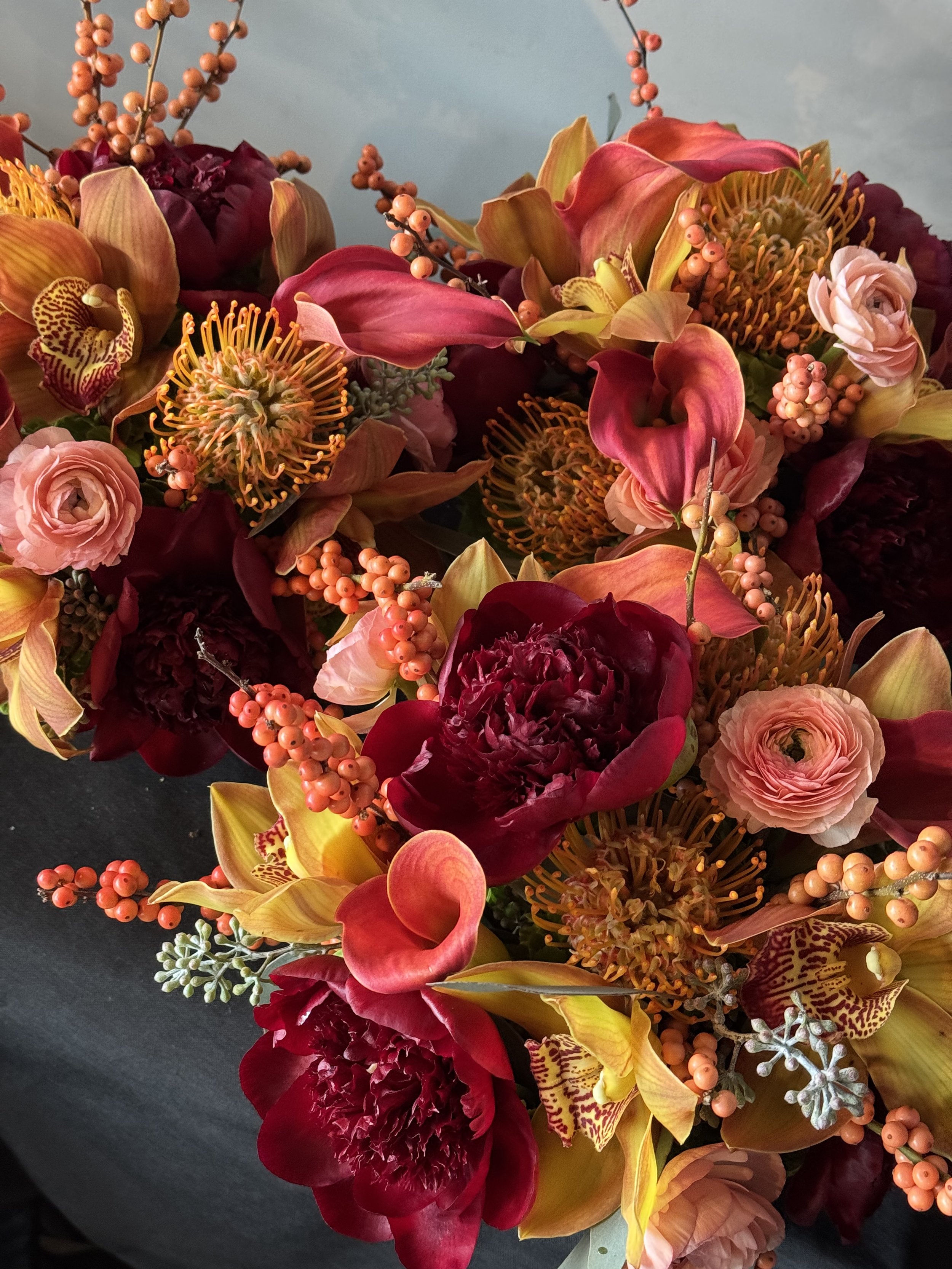
Think about a beautiful piece of jewelry displayed against a simple background. The empty space around it isn't wasted. It helps you appreciate the details, the craftsmanship, and the way light catches the surface. Flowers can work in much the same way.
A single garden rose with soft, layered petals can become the centerpiece of an entire arrangement when it's positioned thoughtfully. Add a delicate branch and two smaller blooms, and suddenly you have something that feels intentional rather than incomplete.
That's the real distinction between a sparse arrangement and a sophisticated one. Minimalist floral design isn't about using fewer flowers just for the sake of it. It's about making every flower count.
This approach also changes how we experience an arrangement. Instead of seeing one large mass of color, your eyes naturally explore each bloom. You notice the curve of a stem, the subtle differences between petals, and the relationship between the flowers and their surroundings.
The result can feel more personal, more artistic, and surprisingly more memorable than an arrangement twice its size.
Why More Flowers Don't Always Mean More Beauty
There's something undeniably wonderful about a big, overflowing bouquet. It can feel romantic, cheerful, and wonderfully generous. But adding more flowers doesn't automatically improve an arrangement, especially when the goal is an elegant, high-end look.
Imagine walking into a room where every wall is covered with artwork. There are beautiful paintings everywhere, but there's so much competing for your attention that you don't know where to look first. Eventually, everything starts blending together.
The same thing can happen with flowers.
When too many blooms compete for attention, their individual shapes and colors can become difficult to appreciate. A delicate orchid might disappear behind a large cluster of roses. An unusual branch might lose its sculptural quality when surrounded by dense greenery.
Instead of creating visual richness, the arrangement can become visually exhausting.
Experienced floral designers understand the importance of a clear focal point. This is the area that naturally catches your eye before you begin noticing the smaller details. In a restrained arrangement, that focal point might be a single dramatic bloom, a graceful stem extending beyond the main composition, or an unexpected combination of textures.
The surrounding flowers support that feature rather than compete with it.
Of course, this doesn't mean large arrangements can't be luxurious. A grand centerpiece filled with hundreds of carefully selected flowers can be breathtaking. The difference comes down to whether the volume serves the design or simply adds bulk.
A well-designed arrangement should have a reason for everything it includes. If removing a few stems makes the overall composition stronger, those stems probably weren't contributing much.
This is one reason high-end floral arrangements often look more effortless than ordinary bouquets. Their beauty comes from thoughtful editing. Designers consider what's necessary, what creates balance, and what might distract from the overall impression.
It's similar to choosing an outfit. Adding another accessory doesn't always make it more stylish. Sometimes, removing one piece allows everything else to shine.
With flowers, knowing when to stop can be just as important as knowing what to add.
The Power of Negative Space in Flower Arrangements
One of the most overlooked elements of floral design isn't a flower at all. It's the empty space around the flowers.
Designers call this negative space, and it can completely change how an arrangement looks and feels.
At first, leaving open areas between stems might seem counterintuitive. Why would someone deliberately create gaps when they could fill those spaces with more beautiful flowers? But those gaps actually help define the arrangement's shape. They allow your eyes to move naturally from one element to another, making the entire composition easier to appreciate.
Consider a branch of flowering quince extending gracefully from a ceramic vase. The branch may hold only a few blossoms, but the open space beneath its curve makes the shape feel dramatic. Fill that space with additional flowers, and the beautiful line of the branch practically disappears.
Negative space also creates a sense of calm.
When flowers are arranged tightly together, the result often feels energetic, lush, and celebratory. When they're given room to breathe, the mood becomes quieter and more contemplative. Neither approach is inherently better, but the second can be especially effective when creating a refined atmosphere.
This is particularly noticeable in modern homes with clean architectural lines, natural materials, and carefully chosen decorative objects. A dense, colorful bouquet might compete with the room's design, while a sculptural arrangement with open space can complement it beautifully.
There's also an interesting psychological element at work. When something is surrounded by space, we tend to notice it more clearly. Our attention isn't constantly being redirected by neighboring details.
That's why a single dramatic bloom can feel surprisingly important in a large, uncluttered composition.
However, negative space needs to be intentional. Random gaps between flowers can make an arrangement look unfinished. Beautiful negative space follows the direction of stems, supports the overall silhouette, and creates a natural visual rhythm.
The goal isn't to make the arrangement look empty. It's to give the flowers room to express their individual character.
In luxury floral design, empty space isn't the absence of beauty. It's part of the beauty itself.
Quality Over Quantity: What Makes Every Stem Matter
Not all flowers contribute equally to an arrangement. Sometimes, one extraordinary stem can do more for the overall design than a dozen ordinary ones. That's why quality over quantity in floral design is much more than a fashionable idea. It's a practical approach that changes how flowers are selected, arranged, and appreciated.
Take a garden rose, for example. Some varieties have densely layered petals that open into soft, irregular shapes. Others have unusual colors, delicate fragrances, or beautifully curved stems. When a flower has that much natural character, it doesn't need a crowd of other blooms to make an impression.
The same applies to flowers like peonies, anthuriums, orchids, and calla lilies. Their distinctive forms can become the foundation of an entire arrangement.
But quality isn't simply about choosing expensive flowers.
A fresh branch of blossoms gathered at the right moment can be just as captivating as an imported specialty bloom. The important thing is finding flowers with strong visual appeal, healthy petals, interesting shapes, and a natural presence that fits the design.
Freshness matters, too. A beautifully arranged flower that's already beginning to wilt won't have the same impact as a healthy stem with good hydration and firm petals. Professional designers pay close attention to flower condition because even small imperfections can become noticeable in a minimalist composition.
When an arrangement contains just five stems, each one receives more attention. There aren't dozens of neighboring flowers to hide a damaged petal or an awkwardly positioned bloom.
This makes careful selection essential.
The angle of a flower head, the length of its stem, and the stage of its opening all become important design decisions. Some flowers look their best when fully open, while others create more interest as tight buds.
An elegant arrangement might combine both stages to suggest movement and natural growth.
Think of it like preparing a memorable meal with only a few ingredients. When you aren't relying on complicated sauces or dozens of flavors, the quality of each ingredient becomes much more noticeable.
Luxury floral arrangements follow the same principle: fewer elements create higher expectations for every element that remains.
That's what makes a carefully selected handful of flowers feel special rather than simply small.
How Shape and Structure Create a Luxury Look
If you've ever admired a flower arrangement that seemed almost like a sculpture, you've probably experienced the power of shape and structure without realizing it.
While traditional bouquets often emphasize fullness and symmetry, many contemporary luxury floral designs use movement, asymmetry, and unexpected proportions to create visual interest.
Instead of forming a perfectly rounded dome, the flowers might rise in different directions. One stem reaches upward, another bends gently outward, and a third hangs slightly over the edge of the vase. Together, these individual movements create a composition that feels alive.
This kind of design has a lot in common with architecture.
An architect doesn't make every building interesting by adding more walls. The relationship between lines, angles, open spaces, and materials determines the overall experience. Floral designers use similar principles, only their building materials happen to be living flowers.
A tall branch can establish height. A broad, open bloom can provide visual weight near the base. A curved stem can connect those two areas, helping the eye move naturally through the arrangement.
The result feels balanced even when the two sides aren't identical.
This is especially important because nature rarely grows in perfect symmetry. Wildflowers lean toward the light. Branches twist as they develop. Some blossoms open earlier than others.
When floral designers embrace those natural differences, their work often feels more organic and expressive.
One particularly effective technique is to establish a strong silhouette before adding smaller flowers. Imagine looking at the arrangement from across the room, where individual petals are difficult to see. Does the overall outline still look interesting?
If it does, the arrangement has a strong structural foundation.
That's also why some designers begin with branches or foliage rather than flowers. These elements establish the direction and movement of the composition, making it easier to position the focal blooms afterward.
The goal isn't to create something perfectly controlled. It's to guide the flowers without making them appear forced.
A well-structured arrangement can look beautifully spontaneous, even though every stem has been positioned with care.
And that's part of its charm. You see the natural movement first, not the effort behind it.
Why Color Restraint Makes Flowers Feel More Expensive
Color can completely change the personality of a flower arrangement. Bright pinks, oranges, yellows, and purples can create an energetic, playful atmosphere. Soft neutrals, muted greens, and carefully coordinated shades often produce a quieter, more sophisticated impression.
Neither palette is automatically luxurious. What matters is how the colors work together.
In minimalist luxury flower arrangements, designers frequently limit the color palette to two or three closely related tones. Instead of combining every attractive color available, they explore subtle variations within a smaller range.
Imagine an arrangement featuring ivory roses, pale cream ranunculus, and soft green foliage. At first glance, the palette seems simple. Look closer, though, and you'll notice how the warm ivory petals contrast with cooler greens. The differences are subtle, but they make the arrangement feel layered rather than flat.
This approach is called a tonal color scheme.
It's especially effective because the flowers don't have to compete through intense color contrast. Their shapes, textures, and natural details become more noticeable.
Another popular approach is monochromatic design, where several shades of one color are combined.
A pink arrangement, for instance, might include dusty rose, soft blush, and deeper mauve tones. These variations create depth while maintaining a cohesive appearance.
But restrained color doesn't necessarily mean pale or neutral.
A few deep burgundy calla lilies against dark green foliage can feel dramatic and sophisticated. A single orange anthurium in a sculptural vase can become a striking focal point. Even a vivid yellow arrangement can feel luxurious when its proportions and color relationships are carefully considered.
The real secret is color intention, not color limitation.
Think about an elegant room with a carefully chosen accent wall. That one strong color often has more impact than painting every wall a different bright shade.
Flowers work similarly.
When the palette is controlled, each color has more room to communicate something. Cream may suggest softness, deep red may create drama, and green can introduce freshness and calm.
Lighting also influences the effect. Warm indoor lighting can make peach and cream flowers feel inviting, while natural daylight reveals delicate differences between white and pale green petals.
Choosing colors with the surrounding environment in mind helps the arrangement feel like a natural part of the space rather than a separate decoration.
That's often what gives restrained floral designs their expensive-looking finish: everything seems to belong together.
Texture: The Secret Ingredient in Minimalist Floral Design
When you're working with fewer flowers, texture becomes one of your most valuable design tools.
It's easy to focus on color and forget how different flowers actually feel visually. Some petals are smooth and glossy. Others are ruffled, velvety, papery, or almost translucent. These differences can make even a small arrangement feel rich and interesting.
Consider the contrast between a sleek anthurium and a soft garden rose.
The anthurium has a smooth, almost polished surface with a strong architectural shape. The rose, on the other hand, features dozens of delicate petals that create softness and movement. Place them together thoughtfully, and you get a compelling contrast without needing many additional flowers.
That's the beauty of texture in floral design.
It gives the eye something to explore beyond color alone.
Branches, seed pods, grasses, and interesting leaves can also introduce texture. A slender branch with rough bark might look beautiful beside a smooth ceramic vase. Fine, airy grasses can soften the appearance of a bold flower with broad petals.
Even the stems themselves contribute.
A straight, polished-looking stem creates a different impression from a twisting, irregular branch. Leaving portions of these natural structures visible can add personality to an arrangement.
But texture needs balance, just like everything else.
If every flower has an unusual surface, complicated shape, or dramatic visual character, the arrangement can become overwhelming. A more effective approach is to choose one dominant texture and introduce one or two contrasting elements.
For example, an arrangement might feature several soft peonies, one structural leaf, and a few delicate flowering branches.
The peonies establish the main texture. The leaf provides contrast. The branches introduce movement and lightness.
Nothing needs to compete for attention.
This technique is particularly useful with neutral color palettes. When flowers share similar colors, their different textures become easier to appreciate.
A white orchid beside white ranunculus doesn't look repetitive because the flowers have such different forms and surfaces.
Texture also changes as flowers age. Some petals become softer and more open, while seed heads develop fascinating shapes. A thoughtfully designed arrangement can acknowledge these changes rather than trying to maintain a perfectly uniform appearance.
The result feels natural, layered, and full of quiet detail.
And sometimes, those little details are exactly what make someone lean closer for a second look.
How the Right Vase Can Transform a Few Flowers
You can spend hours choosing beautiful flowers, but if the vase doesn't suit them, the entire arrangement can feel slightly off.
A vase isn't merely a container that holds water. In a minimalist arrangement, it's an important part of the visual composition. Its shape, material, color, and proportions all influence how the flowers are perceived.
Think about three white calla lilies.
Place them in a tall, narrow glass cylinder, and the result might feel clean and contemporary. Put the same flowers in a low, handmade ceramic vessel, and the arrangement becomes softer and more sculptural. Choose a dark, textured vase, and the white blooms suddenly appear more dramatic.
The flowers haven't changed, but their presentation has.
This is why vase selection is essential in luxury floral design.
A good vessel supports the arrangement's personality without overpowering it.
For flowers with long, expressive stems, a vase with a narrow opening can be especially helpful. It keeps the stems gathered near the base while allowing them to spread naturally as they rise.
Low, wide containers work beautifully for asymmetrical arrangements, particularly when flowers extend horizontally or curve over the edge.
The material matters, too.
Ceramic vessels can introduce warmth, texture, and a handcrafted feel. Clear glass creates a lighter appearance and allows visible stems to become part of the design. Stone-like finishes can add a grounded, architectural quality.
There's no single material that automatically makes an arrangement luxurious.
The right choice depends on the flowers, the room, and the atmosphere you're trying to create.
One common mistake is choosing a vase that's far too large for the number of flowers. Instead of looking intentionally minimal, the arrangement may appear undersized or unstable.
On the other hand, a vessel that's too small can make the flowers feel crowded.
As a starting point, consider the visual relationship between the vase and the flowers rather than following a strict measurement rule. Tall branches often need a vessel with enough weight and stability to support them. Short, dramatic blooms may look best in a low container that keeps the composition visually grounded.
Practical details matter as well. A narrow neck may help support a few stems naturally, while a wide opening might require a reusable flower frog or other mechanics to hold them in position.
The best vase makes the flowers look as though they were always meant to be there.
When that relationship works, even a modest arrangement can feel like a carefully chosen piece of art.
Why Flower Placement Matters More Than Flower Count
Here's a small experiment worth trying. Take five flowers, place them randomly into a vase, and look at the result. Now remove them and arrange the same five stems with attention to height, direction, and spacing.
You'll probably notice a remarkable difference.
The number of flowers hasn't changed. Their colors haven't changed. Yet the second arrangement can look far more polished because flower placement influences how the entire design is experienced.
Professional florists pay attention to these relationships constantly.
They consider which flower should attract attention first, where the eye should travel next, and how the remaining stems can support that movement.
A common technique involves placing one dominant bloom slightly away from the center. This creates a focal point that feels natural rather than overly formal. Smaller flowers can then be positioned at different heights to introduce depth.
The arrangement begins to feel three-dimensional instead of flat.
Depth is particularly important.
When every flower head sits at the same distance from the viewer, the composition can resemble a wall of petals. Moving some blooms forward and others backward creates layers, allowing individual flowers to stand out.
Stem direction also plays a major role.
A flower leaning gently toward the viewer creates a different experience from one facing straight upward. An outward-facing bloom can help extend the arrangement's silhouette, while a smaller flower tucked near the base can create a sense of fullness without adding much volume.
Even slight adjustments can make a difference.
Turning a flower head a few degrees might reveal the most beautiful side of its petals. Lowering one stem can create a more pleasing relationship between two blooms. Removing a leaf may reveal a graceful curve that was previously hidden.
These changes sound tiny, but they add up.
Think about arranging furniture in a living room. Buying another chair won't necessarily improve the space. Sometimes, moving the existing furniture creates a better layout, clearer sight lines, and a more welcoming atmosphere.
Flowers behave in much the same way.
One useful trick is to step away from the arrangement frequently. Look at it from across the room rather than only from directly above the vase. You'll begin noticing whether the composition feels balanced, whether one flower dominates too strongly, or whether an open area needs adjustment.
A photograph can also help reveal awkward spacing.
The most impressive minimalist arrangements rarely happen by accident. They look effortless because someone has paid attention to dozens of small decisions that most viewers will never consciously notice.
That's the difference between simply placing flowers in a container and actually designing with them.
Seasonal Flowers and the Beauty of Natural Simplicity
There's something special about flowers that genuinely reflect the time of year. Spring branches covered in delicate blossoms, summer dahlias with their intricate petals, or autumn stems carrying unusual seed pods all bring a sense of place and season into a room.
This seasonal character can make a small arrangement feel surprisingly meaningful.
Rather than relying on large quantities of flowers to create visual excitement, seasonal floral arrangements often draw attention to something naturally distinctive about the moment.
A few flowering branches in early spring, for instance, can be incredibly beautiful. Their irregular shapes, tiny buds, and delicate blossoms tell a story about the changing season. They don't need to be surrounded by dozens of additional flowers because their natural character already provides plenty of interest.
The same principle works throughout the year.
In late spring, a few lush peonies can create a romantic arrangement with very little supporting material. During summer, garden roses or dahlias can bring rich color and texture. In fall, branches with colorful leaves, grasses, and sculptural seed heads offer a different kind of beauty.
Winter arrangements can feature evergreen branches, berries, bare twigs, or a handful of elegant blooms against a restrained background.
Of course, seasonal availability varies by climate, growing conditions, and local supply. A flower that's abundant in one region may be difficult to find in another.
That's why it's useful to approach seasonal design with curiosity rather than a fixed shopping list.
Visit a local flower market and notice what's looking especially fresh. Pay attention to unusual foliage, interesting branches, and flowers at different stages of opening. Sometimes, the most beautiful material isn't the one you originally planned to use.
Working with seasonal flowers can also introduce wonderful imperfections.
A branch might curve unexpectedly. Two blossoms may open at slightly different angles. The leaves might have subtle color variations that would be impossible to recreate artificially.
Instead of correcting every irregularity, a thoughtful designer can make those characteristics part of the composition.
That's what gives naturally inspired floral arrangements their relaxed elegance.
They feel connected to the outdoors rather than manufactured to look identical.
Seasonal simplicity also encourages a more personal relationship with flowers. You start noticing what appears at different times of the year, which varieties have the most interesting shapes, and how the natural world changes.
A few well-chosen stems can capture that feeling beautifully.
Sometimes, the luxury isn't having every flower available all the time. It's enjoying something exceptional while it's naturally in season.
Can Fewer Flowers Make an Arrangement More Sustainable?
Sustainability is becoming an important consideration in floral design, and smaller arrangements can offer some practical advantages. Using fewer stems may reduce the amount of floral material required, while thoughtful design can also limit unnecessary foliage, packaging, and decorative accessories.
However, there's an important distinction to make: fewer flowers don't automatically mean a smaller environmental footprint.
The environmental impact of an arrangement depends on several factors, including where the flowers were grown, how they were produced, how far they traveled, and what happens to the materials afterward.
For example, a small arrangement featuring a few heavily refrigerated, long-distance imported flowers isn't necessarily more sustainable than a larger arrangement made with locally grown seasonal blooms.
Growing methods matter, too. Heating greenhouses, using irrigation systems, applying agricultural chemicals, and transporting flowers all contribute to the overall environmental picture.
That's why responsible floral design involves more than simply reducing the number of stems.
Still, minimalist arrangements can encourage some useful habits.
When you buy fewer flowers, you may have more flexibility to choose carefully. Instead of purchasing a large mixed bouquet without knowing much about its origin, you can focus on a small selection of healthy, seasonal flowers from a grower or supplier whose practices you understand.
Reducing unnecessary materials can make a difference as well.
Traditional floral arrangements sometimes rely on single-use plastic accessories, excessive wrapping, or floral foam. Certain conventional floral foams are made from synthetic materials that don't readily biodegrade.
Alternatives such as reusable flower frogs, carefully designed branch supports, and suitable vase shapes can help reduce reliance on disposable mechanics.
A small arrangement may also require less maintenance material and create less organic waste at the end of its display life.
But even here, context matters. A large installation designed with reusable equipment and locally sourced flowers might represent a more thoughtful choice than several small arrangements involving unnecessary packaging and shipping.
Another useful practice is choosing flowers that have a good vase life.
Keeping stems in clean water, removing submerged leaves, trimming stems when appropriate, and placing arrangements away from excessive heat can help maintain their appearance.
Some flowers naturally last longer than others, so understanding the varieties you're using is valuable.
When the arrangement finally fades, composting suitable plant material where local facilities permit can be another practical step.
The bigger lesson is that sustainability comes from a combination of decisions.
Using fewer flowers creates an opportunity to be more intentional, but responsible sourcing, reusable materials, and proper flower care matter just as much.
Why Minimalist Luxury Arrangements Aren't Necessarily Cheaper
It's easy to assume that a flower arrangement with six stems should cost significantly less than one containing thirty.
Sometimes, it does. Fewer flowers can mean lower material costs. But when it comes to professionally designed luxury arrangements, the relationship between flower count and price isn't always that straightforward.
That's because you're not simply paying for the number of flowers inside the vase.
You're also paying for selection, design expertise, preparation, sourcing, and the time required to create a polished composition.
Imagine commissioning an arrangement featuring three unusual orchids, two sculptural branches, and a handmade ceramic vessel. The flower count might be low, but the individual stems could be relatively expensive or difficult to source.
The designer may also spend considerable time finding flowers with precisely the right shape, maturity, and color.
Once the materials arrive, each stem needs preparation.
Some flowers require careful hydration or conditioning before they're ready to use. Others have delicate petals that can be easily damaged during handling. A designer may need to inspect several stems to find the best ones for a particular composition.
Then comes the actual design work.
With a dense bouquet, small irregularities can sometimes disappear among the surrounding flowers. A minimalist arrangement offers fewer places to hide mistakes.
The designer must consider exact positioning, stem support, balance, stability, and the relationship between the flowers and the vessel.
That attention requires skill.
A useful comparison is a beautifully tailored jacket. The value doesn't depend on how much fabric the tailor used. It comes from the quality of the material, the precision of the fit, and the craftsmanship involved.
Floral design works in a similar way.
Here's a simple comparison of the factors that can influence different styles of arrangements:
Feature
Full, Traditional Arrangement
Minimalist Luxury Arrangement
Flower quantity
Usually higher
Usually lower
Main visual appeal
Abundance and fullness
Shape, detail, and composition
Stem selection
Consistency and overall harmony
Strong individual character
Design approach
Often layered and densely arranged
Often open and sculptural
Vase importance
Supports the overall bouquet
Can be a central design element
Labor requirements
Can be substantial
Can also be substantial
Final price
Depends on flowers, scale, and labor
Depends on flowers, vessel, and expertise
Neither style is automatically more expensive.
A simple arrangement of five seasonal flowers in a basic vase may be very affordable. A large arrangement using common flowers might also offer excellent value. Conversely, a minimalist composition featuring rare blooms and extensive custom design work can be costly.
The important thing is understanding what you're actually paying for.
If you're ordering a luxury floral arrangement, ask about the flower varieties, vessel, overall dimensions, and design approach rather than judging value by stem count alone.
A small arrangement should still feel complete, thoughtfully composed, and appropriate for its intended setting.
Luxury isn't a promise that fewer flowers will always cost more. It's the expectation that every element contributes to the finished design.
Where Minimalist Luxury Flower Arrangements Make the Biggest Impact
One reason minimalist arrangements are so versatile is that they can transform a space without overwhelming it.
A large bouquet naturally demands attention. Sometimes that's exactly what you want. But in rooms where architecture, lighting, furniture, or other decorative elements already create visual interest, a more restrained floral design can be surprisingly effective.
Consider a modern dining table.
A tall, densely packed centerpiece might look beautiful from across the room, but it can block conversation when people sit down to eat. A low arrangement featuring a few carefully positioned flowers can provide elegance without interrupting sight lines.
That balance makes minimalist centerpieces especially appealing for intimate dinners.
They add atmosphere while allowing the experience itself to remain the focus.
Entryways are another excellent setting.
Imagine stepping into a home and noticing a single sculptural arrangement on a narrow console table. A few long branches reach upward, while one or two dramatic flowers provide color near the base.
The composition feels welcoming without cluttering the entrance.
In a bedroom, a small arrangement on a nightstand can add softness and personality. A few fragrant flowers may be pleasant, although strong scents aren't ideal for everyone, particularly people who are sensitive to fragrance.
For workspaces, compact floral arrangements can introduce a natural element without taking over valuable desk space.
Minimalist flowers also work beautifully in settings where a carefully controlled atmosphere matters, such as galleries, private dining rooms, boutique-style interiors, and sophisticated event spaces.
In these environments, flowers often serve as part of the overall design rather than the main attraction.
They complement materials, colors, and architectural features.
Weddings offer another interesting example.
Not every couple wants towering centerpieces or enormous floral installations. Some prefer small arrangements with meaningful flowers, sculptural branches, or a limited color palette that complements the venue.
A few dramatic stems placed at carefully selected points can create a cohesive visual story.
Of course, scale still matters.
A tiny arrangement on a huge table may disappear visually, while a tall composition in a narrow hallway can become inconvenient. Choosing fewer flowers doesn't mean ignoring the dimensions of the space.
Instead, it means using placement, proportion, and repetition strategically.
For a long dining table, several small arrangements may create more visual rhythm than one oversized centerpiece. On a large reception desk, a single dramatic composition with strong vertical lines might have greater impact than a compact round bouquet.
The key is to design for the surroundings.
A successful minimalist arrangement doesn't need to dominate the room. It needs to feel as though it belongs there—and makes the space better because of its presence.
How to Create a Luxury Flower Arrangement With Fewer Stems
You don't need professional training or an enormous flower budget to experiment with minimalist floral design. In fact, starting with fewer stems can be a wonderful way to develop your eye for proportion, color, and natural movement.
The secret is to approach the arrangement as a composition rather than a container that needs filling.
Begin by choosing a clear direction.
Do you want something soft and romantic, bold and architectural, or natural and relaxed? Having a general mood in mind will make the next decisions easier.
For a simple starting arrangement, consider using five to seven stems. That might include three focal flowers, one or two smaller blooms, and a couple of interesting branches or pieces of foliage.
This isn't a strict formula. Some beautiful arrangements use only one flower, while others need more stems to achieve their intended shape.
The point is to begin with a manageable selection.
Step 1: Choose one standout flower. Look for a bloom with a beautiful shape, interesting color, or distinctive texture. A garden rose, orchid, dahlia, or calla lily could work depending on what's available.
Step 2: Select supporting materials. Choose flowers or foliage that complement the main bloom without competing with it. Think about contrast in texture, height, or movement.
Step 3: Find a suitable vase. A vessel with a narrow opening can make it easier to position fewer stems. Make sure it's clean, watertight, and stable enough for the materials you've selected.
Step 4: Prepare your flowers. Remove foliage that would sit below the waterline, trim stems appropriately, and use fresh water. Follow any special care recommendations for your chosen flowers.
Step 5: Establish the overall shape. Begin with your tallest or most expressive stem. Let its natural curve guide the direction of the composition rather than forcing it into a perfectly upright position.
Step 6: Add your focal blooms. Position the main flowers at slightly different heights and depths. Avoid lining every flower head up at the same level.
Step 7: Create balance with supporting stems. Introduce smaller flowers or foliage where they help connect the composition. Leave some open space so the individual shapes remain visible.
Step 8: Edit the arrangement. Step back, look from different angles, and remove anything that makes the design feel crowded.
That last step may be the most important.
It's tempting to keep adding flowers because you have them available. But a beautiful arrangement doesn't need to use every stem you purchased.
If something feels unnecessary, try removing it and comparing the result.
You might be surprised by how much stronger the arrangement becomes.
A few additional habits can help.
Keep the tallest stem proportional to the vessel and make sure the arrangement doesn't become top-heavy. Rotate the vase as you work, especially if it will be visible from several directions. If it's intended for a wall-facing console, you can design primarily for the front and sides.
Also, don't fight the natural personality of your flowers.
A gracefully curved stem usually looks better when you embrace that curve. A flower that naturally faces sideways may be more interesting positioned at an angle than forced to face forward.
Finally, remember that flowers change.
Some blooms will open wider over the next few days, while others may begin to soften or fade. Give them enough space to develop, and adjust the arrangement when needed.
The goal isn't perfection. It's creating something that feels balanced, expressive, and intentional.
That's what gives a handful of flowers the ability to make a genuinely luxurious impression.
Conclusion
The most memorable flower arrangements aren't always the biggest, brightest, or most expensive. Sometimes, the ones that stay with us are surprisingly simple: a beautifully curved branch, a few extraordinary blooms, and a vase that makes everything feel perfectly balanced.
That's the appeal of luxury floral arrangements with fewer flowers.
They invite us to appreciate details we might otherwise overlook. The delicate shape of a petal, the graceful movement of a stem, or the subtle contrast between two textures becomes more noticeable when there's nothing unnecessary competing for attention.
But minimalism doesn't mean removing flowers until there's barely anything left.
It's a way of thinking about design.
Instead of asking how many flowers can fit inside a vase, you begin asking what each flower contributes. Does it add movement? Does it introduce contrast? Does it strengthen the focal point? Does it help the arrangement feel connected to its surroundings?
Those questions lead to more thoughtful results.
They also challenge the assumption that luxury must always be measured by abundance.
An arrangement doesn't need fifty flowers to feel exceptional. It needs a clear visual idea, carefully chosen materials, and enough confidence to let its strongest elements stand on their own.
That confidence is often what makes a minimalist arrangement so compelling.
There's no pressure to impress through size alone. The beauty comes from the relationships between the flowers, their container, the surrounding space, and the person experiencing them.
Of course, abundant arrangements have their own magic. A room filled with flowers can create an atmosphere that's impossible to achieve with just a handful of stems. Floral design has room for both approaches, and neither needs to replace the other.
The important thing is choosing the style that best expresses the occasion and setting.
For some celebrations, that means overflowing arrangements filled with color and fragrance. For others, a quiet composition featuring a few exceptional blooms feels more appropriate.
Next time you're choosing flowers, try looking beyond the number of stems.
Notice their shapes. Think about where they'll be displayed. Consider whether one unusual flower might say more than a dozen ordinary ones.
You may discover that the most beautiful luxury isn't always about having more. Sometimes, it's about noticing more in what you already have.